
Pharmacy First Changes: Questions and Answers (FAQs)
Published: 04/12/25
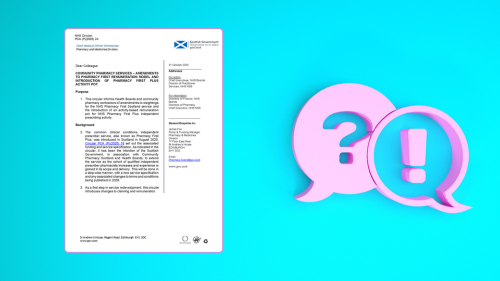
We have put together the following Frequently Asked Questions (FAQs) from the circular PCA P(2025)24. We have split the questions into three categories:
Links to the various documents here
Circulars
NHS PFS Service Original Circular PCA P(2020)13
IP Service Original Circular PCA P(2020)16
UCF Intro for NHS PFS Plus Circular PCA P(2024)32
NHS PFS Update Nov 2025 Circular PCA P(2025)24
PMR System and Suppliers
-
Yes. There have been no changes required to PMRs beyond those made in February 2025. Please ensure that you follow the Flow Chart.
Any specific system questions need to be directed to the system suppliers
-
Each PMR may have a its own user interface for UCF with slight differences between systems. The key to accurate claiming is to ensure that the correct ‘parent’ service and then sub-service are selected. For example, to claim for a PFS+ consultation where a GP10P has been written, the user should select “Pharmacy First Plus (IP)” then “Supply” (this option may appear as “treatment” in some PMRs). Any specific system questions need to be directed to the system suppliers
Finance
-
This change has been made as part of the system review to reflect the level of the workload associated with NHS PFS Plus supply, about which there has been significant feedback.
The advice and referral are still remunerated from the standard pharmacy first activity pool.
The £3000 payment for service availability is still made to eligible contractors.
-
No, as these are paid from a pot, the values vary each month.
-
Yes – providing that there are 25hours of availability spread across the week.
So , for example 5 CPIPs working 5 hours each covering different days, then yes. However, 5 CPIPs all working 5 hours on the same day does not give a spread of cover across the week and would not therefore be eligible for payment.
-
This is calculated automatically by the system from the new NHS PFS Plus Pot.
The £40 is a capped payment. Payments per item will not exceed this cap.
The £30 is a minimum payment which will be paid irrespective of volumes claimed.
-
The full list is reviewed every three years, in line with the policy for all formularies.
If an item is removed in the time between these reviews, there is a grace period of two months during which the previous products can be supplied.
Best practice is to supply precisely as the items appear on current approved list.
-
The full service will be regularly reviewed ongoing to monitor the remuneration and results, and make any changes as required.
-
Yes.
This is part of the FV SLA, and not part of the national service.
CPIPs use GP10 P and make a local claim at the end of the month.
Pharmacists who are not IPs use the PGDs and make a local claim at the end of the month.
The NHS PFS Service claim process should not be used for this Local Forth Valley Service.
Process
-
Where the NHS PFS consultation could not be dealt with by a member of the team using the advice/refer/treat and/or Approved List or PGD elements of the service and had to be referred to the CPIP for specific IP consultation, this would be NHS PFS Plus.
The NHS PFS Plus claims will only be made where the consultations could not be undertaken by anyone other than the CPIP
-
Ideally, CPIPs would use their prescription pads whenever possible. However, with the admin surrounding these, the CPIP can use whichever method they prefer in this circumstance.
When a CPIP Uses the PGD, they should follow the process on the Flowchart for PGD supply
-
No.
The service can only be delivered by employee CPIPs who have been signed off by their NHS boards and have their own GP 10 P pads for prescribing.
-
Yes.
These pads are linked to individual CPIPs and also to local NHS budgets. Individual Boards can provide advice on how prescription pad governance and management.
-
CPS and Scottish Government colleagues are aware of the limitations of the current system, and discussions are ongoing around this.
-
These are found in the service specification and the key principles.
The link to these is in the NHS PFS Resource and Flowchart document which is also on the CPS Website. We would encourage pharmacy teams to refer to this document when in doubt rather than only using the PMR messages as a guide, in particular where a patient does not have a CHI number as this does not automatically mean that the patient is ineligible for the service.
The full eligibility list has been added on Pages 8-10 of the document too
-
No.
The Directions and Service Specifications detail that NHS PFS Service providers, must not offer any incentive or inducement to the public to use NHS PFS.
-
No.
The Directions and Service Specifications detail that NHS PFS Service providers, must not offer any incentive or set any targets inducement for teams for any aspect of the NHS PFS Service.
-
Work is ongoing on future PGDs, details of which will be shared as soon as they are available.
-
This is not part of the service as it is currently set up ; it is intended as a walk-in service accessed by patients. However within individual localities, CP and GP Teams can agree a plan for how referrals GP->CP can operate, ensuring that the availability and capacity of the CP for all areas of patient care are maintained.
In the meantime, the circular can be found here, and any questions directed to enquiries@cps.scot.

























Our Chief Executive Matt Barclay and Policy & Public Relations Pharmacist Sarah Staddon are at #SNPConference in Aberdeen today