Procedure for Dispensing Private Prescriptions for Controlled Drugs
Published: 27th May 2026
Our colleagues at the GPhC Inspectorate have asked us to pass on a friendly reminder as to the procedures required for Community Pharmacies to appropriately deal with Private Prescriptions for Controlled Drugs.
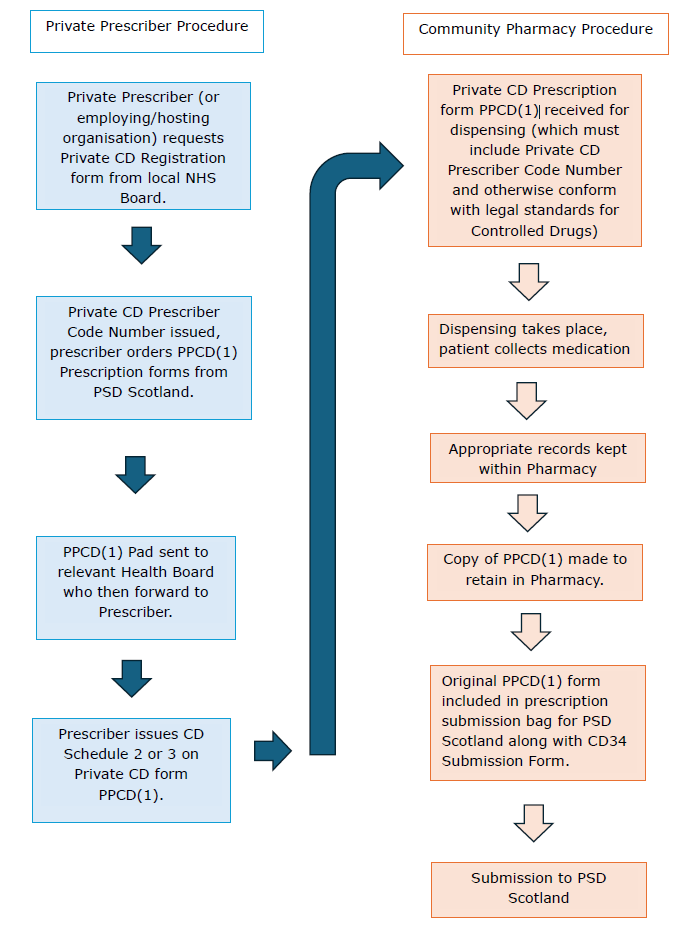
Private Prescriptions for Schedule 2 and Schedule 3 Controlled Drugs (CDs) should be issued on designated PPCD(1) forms in Scotland. HDL(2006)27 issued instructions on the arrangements for prescribing of Schedule 2 and 3 CDs by private prescribers, this included the requirement for information on private prescriptions for CDs to be collected on a similar basis to that for NHS primary care prescriptions. This led to the following:
The pharmacy which dispenses the PPCD(1) should submit the form(s) to NSS
PPCD (1) forms should be accompanied by a CD34 submission form . For a supply of CD34 forms, please email nss.pcfs-businessupport@nhs.scot or call 01506 705101.
NHS Boards will be able to request retrieval of individual prescription forms. There is a legal requirement to submit all prescriptions for Schedule 2 and 3 CDs to PSD Scotland following completion of dispensing, including private prescriptions. The purpose of this is to enable the accurate monitoring and review of controlled drug prescribing by all prescribers, and to ensure that patients are managed safely.
A copy of the PPCD(1) form should be kept in the pharmacy
All records should be maintained as appropriate in the pharmacy.
Similarly, private requisitions of controlled drugs must be written on standardised CDRF forms, with a similar process for the prescriber to follow to obtain the forms.
Further information is available here: HDL (2006)27: Safer Management of Controlled Drugs (CDs): Private CD Prescriptions and Changes to NHS Prescriptions , and the detail is summarised in the flow chart below:
Scottish Government has officially launched a pilot for Video Remote Interpreting (VRI) in community pharmacy settings.
This year’s two-week Pharmacist campaign focuses on personal and workplace wellbeing and takes place Monday 2nd – Sunday 15th November.
CPS recently wrote to you all, inviting you to join some WhatsApp groups, and asking for details of the person who looks after the finance in your pharmacy/organisation.
Updated SDCEP guidance helps pharmacists and other healthcare professionals assess and manage patients presenting with acute dental problems.
Matt spent some time at the Pharmacy Show in Birmingham this week and, as ever, it was a useful opportunity to step away from the day-to-day and spend time talking to people from across community pharmacy.
Sarah Staddon is back at CPS!! Read her blog on Motherhood, Media Interviews and Everything In Between.
The Drug Tariff Part 11 discount clawback rate has been reset to 6.31%, effective from 1st September 2026.
Community pharmacy teams are asked to display the Be the Early Bird poster and support the Scottish Government’s cancer awareness campaign.
Locum pharmacists in Scotland must meet new legal requirements under the Protecting Vulnerable Groups (PVG) Scheme.
Correction to Creon® SSP information: SSP061 is extended until 8th January 2027, while SSP060 expired on 2nd October 2026.
This week’s MCR Ready Reckoner has been updated and is now available to download or you can view it via the App.
Today, I represented Community Pharmacy Scotland on BBC Scotland television and BBC Radio Scotland, discussing the availability of private flu vaccinations in community pharmacy and how people can prepare for winter
Check out our Monthly Planner: key dates, deadlines and events for community pharmacy in Scotland, all in one place and updated throughout the month.
Newly qualified Pharmacist Independent Prescribers are invited to share their experiences as part of a University of Strathclyde study.
The latest Scottish Pain Pharmacy Network newsletter highlights pain management developments, CPD opportunities and prescribing resources.
Our colleagues at the GPhC Inspectorate have asked us to pass on a friendly reminder as to the procedures required for Community Pharmacies to appropriately deal with Private Prescriptions for Controlled Drugs.
If you have completed your Community Pharmacy Independent Prescribing Training on the Community Pharmacy Scotland (CPS) / PSD Scotland (formerly NES) Programme, a Teach & Treat (T&T) session at one of the hubs is included as part of your programme.
Seriouse Shortage Protocols for selected Estradot® patches and Creon® capsules have been extended until 8th January 2027.
Practical guidance to help pharmacy teams avoid courier collection issues and ensure prescription bags are collected correctly.
October 2026 Scottish Drug Tariff changes including Part 7 additions, deletions and updates to adjusted price arrangements.
The Sustainable Prescribing and Therapeutics Programme, are seeking examples of best practice in effective medicines use and approaches on reducing medicines waste within different healthcare settings
New drug death figures reinforce the need for a nationally commissioned substance use service and a stronger role for community pharmacy.
Updates to the NHS Pharmacy First Scotland Approved List from October 2026, including new formulary entries and eczema products.
Community Pharmacy Scotland (CPS) has agreed a funding settlement with the Scottish Government for 2026/27, providing increased funding certainty for Scotland's community pharmacy network.
Details of the 2026/27 community pharmacy funding package, including Global Sum, guaranteed funding and remuneration arrangements.
The Scottish Parliament recently debated the growing challenge of health misinformation, including its impact on public confidence in healthcare and vaccination programmes.
Important information on Post Registration Foundation Training and Community Pharmacist Independent Prescriber training opportunities.
Applications are open until 30 September 2026 for the Post-Registration Programme for Pharmacists (Scotland).
A reminder for contractors to review PVG Scheme membership records and ensure relevant pharmacy staff are correctly linked to their employer.
Frequently Asked Questions (FAQs)
-
Private prescriptions for Schedule 2 and Schedule 3 Controlled Drugs should be issued on a designated PPCD(1) form in Scotland.
-
There is a legal requirement for all prescriptions for Schedule 2 and 3 Controlled Drugs, including private prescriptions, to be submitted after dispensing. This supports accurate monitoring and review of Controlled Drug prescribing and helps ensure patients are managed safely.
-
Once dispensing is complete, the pharmacy should submit the PPCD(1) form to NSS for processing.
Digital Communications Officer

Our Chief Executive Matt Barclay and Policy & Public Relations Pharmacist Sarah Staddon are at #SNPConference in Aberdeen today